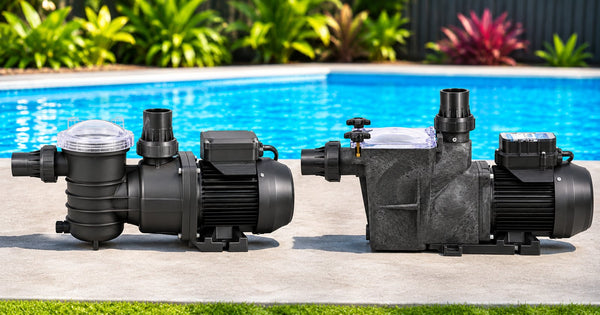

Your filter does the heavy lifting in keeping pool water clear. It traps dirt, leaves, sunscreen, body oils and fine particles so your sanitiser can do its job. Whether you're building a new pool or replacing an old filter, the choice usually comes down to two types: a media filter or a cartridge filter.
Both do a great job when they're sized and maintained correctly. The right one for you depends on how you like to look after your pool, where your pool is, how much water you can use, and, for an existing pool, how your equipment is already set up.
How a media filter works
A media filter is a tank filled with a bed of filter media, traditionally sand and increasingly recycled glass. Water from the pump enters the top of the tank, passes down through the media, and is collected by lateral arms at the bottom before returning to the pool. Dirt is trapped in the media bed.
When the filter gets dirty, the pressure gauge rises. You then backwash: turn the multiport valve to reverse the flow, flushing the trapped dirt out to waste. A short rinse resettles the bed and you're back to filtering.
Sand or glass? Glass media such as Poolrite's Diamond Kleen is a popular upgrade to sand. It filters finer particles and typically needs less backwashing, which saves water. It's also long-lasting, so you'll replace media less often. Read more in the differences in pool filter media.
Poolrite's S-Series media filters (S-5000, S-6000 and S-8000) have one-piece, seamless roto-moulded tanks made in Australia, swivel lateral underdrains and the V2000 multiport valve.
How a cartridge filter works
A cartridge filter uses a pleated fabric element inside a sealed tank. Water passes through the pleats, which catch fine debris. Because the pleats give a large surface area, a cartridge filter traps very fine particles, down to around 10–15 microns.
There's no backwashing. When the pressure rises, you switch off the pump, open the lid, lift out the cartridge and hose it clean. Periodically the cartridge also needs a soak in a cartridge cleaner to remove oils, and eventually it is replaced.
Poolrite's C-Series cartridge filters (CL50, CL100, CL150 and CL200) have a reusable polyester cartridge, a lock-ring lid for easy access, automatic air bleed, internal pressure relief and configurable 40 mm ports.
Media vs cartridge at a glance
| Media filter (glass or sand) | Cartridge filter | |
|---|---|---|
| How you clean it | Backwash and rinse with the valve, a few minutes | Remove the cartridge and hose it down, roughly 15–30 minutes |
| Water use when cleaning | Uses water to backwash (less with glass) | Some hosing water, no backwash to waste |
| Filtration | Good; finer with glass media | Very fine, around 10–15 microns |
| Ongoing costs | Media lasts many years (glass longest) | Cartridge replacement every 1–2 years, plus cleaner |
| Effort | Low: turn the valve and you're done | Hands-on, but less frequent in quiet periods |
| Heavy debris and big storms | Handles it well; WASTE setting lets you vacuum straight out or lower the water level | Clogs faster, so expect more frequent cleaning |
| Plumbing | Needs a waste line to a legal discharge point | No waste line needed |
| Footprint | Larger, heavier tank once filled | Compact, but needs head-room to lift the cartridge out |
| Best for | Larger pools, leafy yards, owners who want a quick clean | Smaller pools, water-restricted areas, sites with no backwash point |
Building a new pool: which should you choose?
With a new pool you have a clean slate, so pick the filter that suits your lifestyle and site, then design the plumbing around it.
Choose a media filter if:
- You want the quickest, easiest clean. Backwashing takes a few minutes and you never handle a dirty cartridge.
- Your yard has trees, or your area gets heavy summer storms.
- You have a medium to large pool or a high bather load.
- There's a suitable place to discharge backwash water. Glass media like Diamond Kleen cuts the water you use.
Choose a cartridge filter if:
- Your local council or water authority restricts backwash discharge, or there's no practical waste point on your block.
- You want to save water and don't mind a hands-on clean every few weeks in peak season.
- You have a smaller pool, plunge pool or spa where a compact unit makes sense.
- Equipment space is tight. Just leave enough head-room to lift the cartridge out.
Ask your pool builder to size the pump and filter together. The pump's flow at your pool's actual operating head should not exceed the filter's rated maximum flow.
Existing pool? Check the symptom before you replace the filter
Cloudy water, weak flow or high pressure don't always mean the filter has failed. Often a worn part or water chemistry is the real cause, and a repair costs far less than a new filter.
| Symptom | Likely cause | What to check or replace |
|---|---|---|
| High pressure, weak return flow | Dirty media or cartridge, or a blockage after the filter | Backwash or clean the cartridge, then compare the gauge with its clean reading at the same pump speed |
| Low pressure, weak return flow | A problem on the suction side, not the filter | Skimmer and pump baskets, water level, air leaks at the pump lid or unions |
| Cloudy water, normal pressure | Water chemistry or not enough run time | Sanitiser and water balance, daily run time, a worn cartridge or tired media |
| Sand or glass returning to the pool | Broken lateral arm or standpipe, or the wrong media grade | Replace the lateral assembly and refill with the correct media |
| Leak at a union or the valve | A worn O-ring or seal | Replace O-rings, the valve gasket or the V2000 top assembly |
| Crack in the tank | Damaged pressure vessel | Stop using it straight away and replace the filter. Never try to patch a pressurised tank |
Poolrite stocks replacement cartridges, lateral assemblies, V2000 valve parts, gauges and O-rings, so a sound filter can often be put back in service. If the tank is damaged or undersized, read on.
Replacing the filter on an existing pool
For an existing pool, the simplest and usually cheapest option is to replace like with like. Your plumbing, pump and equipment pad are already set up for that type of filter.
Staying with media? If your old sand filter is working but the water isn't as clear as it used to be, the media may simply be worn out. Re-filling with Diamond Kleen glass media is a cost-effective upgrade. If the tank or valve is cracked, aged or leaking, a new S-Series filter with a V2000 valve is a straightforward swap for most installations.
Switching from media to cartridge? This is common in water-conscious areas. Check:
- Plumbing changes. The multiport valve and waste line are no longer needed, and the inlet and outlet pipework will need re-routing to the cartridge filter's ports.
- No WASTE setting. You lose the option to vacuum straight to waste or drop the water level after heavy rain through the filter.
- Head-room. The cartridge must lift out vertically. For example, the CL150 and CL200 need about 1.56 m of clearance from the base to remove the element.
Switching from cartridge to media? You'll need a valid backwash discharge point and room for a heavier tank once it's filled with media. The plumbing will need to suit the multiport valve.
Check your pump at every speed. Whatever filter you choose, it must suit your existing pump. Size the filter to the pump's flow at your pool's operating pressure, not to pool volume alone. A filter rated below your pump's flow will run at high pressure, filter poorly and wear faster. With a variable-speed pump, check the filter's limits at the highest speed you'll use. A media filter also needs enough flow to backwash properly. Allow for any chlorinator, heater or cleaner on the same line too.
Check where backwash water can go. Councils and water authorities set rules for backwash discharge, and a nearby stormwater drain isn't automatically allowed. Confirm the rules for your property before adding a media filter.
Compare the installed price, not just the filter price. A like-for-like swap often reuses the existing connections. Changing filter type can add pipework, valves, equipment-pad changes and, for media, a waste line. Ask your installer to list these separately.
Safety first. Never open a filter lid, release a clamp or turn the multiport valve handle while the pump is running or the filter is under pressure. Follow the owner's manual and use a licensed tradesperson for plumbing and electrical work.
If you're also replacing an old pump, it's a good time to consider a variable-speed model such as the SQ Pro to cut running costs.
Sizing your filter: the Poolrite range
Start with your pool volume (try our Pool Volume Calculator), then match a filter whose maximum flow comfortably covers your pump's flow.
| Filter | Type | Max flow (L/min) | Glass media (Diamond Kleen M10 + M20) | Notes |
|---|---|---|---|---|
| S-5000 | Media, 20" tank | 200 | 45 kg + 30 kg | V2000 multiport valve |
| S-6000 | Media, 25" tank | 280 | 90 kg + 45 kg | V2000 multiport valve |
| S-8000 | Media, 30" tank | 450 | 120 kg + 45 kg | V2000 multiport valve |
| CL50 | Cartridge, 50 ft² | 325 | — | 0.87 m clearance to remove element |
| CL100 | Cartridge, 100 ft² | 370 | — | 1.08 m clearance to remove element |
| CL150 | Cartridge, 150 ft² | 470 | — | 1.56 m clearance to remove element |
| CL200 | Cartridge, 200 ft² | 470 | — | 1.56 m clearance; most filter area for the same footprint |
For a cartridge filter, going up a size gives more filter area. That means longer between cleans and a longer cartridge life, so upsizing is worthwhile. Not sure? Your local Poolrite dealer can recommend the right combination.
Frequently asked questions
Which filter gives clearer water?
Both can keep water sparkling. A cartridge element captures very fine particles, and glass media filters finer than sand. In practice, how well the filter is sized and maintained matters more than the type. Good water chemistry and enough daily run time matter just as much.
Which filter uses less water?
A cartridge filter, because there's no backwash, although you still use some water hosing the cartridge clean. If you prefer a media filter, glass media reduces backwash water compared with sand.
How often should I clean my filter?
Backwash a media filter, or clean a cartridge, when the pressure gauge reads about 50–70 kPa above its clean starting pressure. In peak summer that may be every few weeks; in winter much less often.
Can I put glass media in my existing sand filter?
In most cases, yes. Use the glass fill quantities for your tank size and rinse the new media well at start-up. Check your filter's manual or ask your dealer.
How long does a cartridge last?
Typically 1–2 years with regular cleaning. Replace it if the fabric is torn, the pleats are flattened, or the filter won't hold a low pressure after cleaning.
Do I need a new pump if I change filter type?
Not always. If your pump's flow at its normal operating speeds sits within the new filter's rated maximum, you can usually keep it. If the pump is oversized for the new filter, or it's old and inefficient, replacing both together makes sense.
Is changing sand to glass the same as switching to a cartridge filter?
No. Glass media goes into your existing media filter, so you keep the same tank, valve and backwash routine. Switching to a cartridge filter changes the whole filter and the plumbing around it.
How much space does a cartridge filter need above it?
Enough to lift the full cartridge out. For Poolrite's C-Series, allow about 0.87 m (CL50), 1.08 m (CL100) or 1.56 m (CL150 and CL200) from the base.
Can I swap my media filter for a cartridge filter myself?
It involves cutting and re-plumbing pressurised pipework. We recommend using a qualified pool technician.
The bottom line
There's no single "best" filter, only the best one for your pool. Choose a media filter with glass media for fast, easy cleaning, good debris handling and a long service life. Choose a cartridge filter if you want maximum water savings, very fine filtration or have no backwash point. For an existing pool, replacing like with like is usually simplest, unless you have a clear reason to switch.
Poolrite has designed and made pool equipment in Australia since 1978. Explore our filter range or find a Poolrite dealer near you for advice on the right filter and pump for your pool.
Need a hand?
Our team can help with Poolrite pumps, filters, skimmers and parts. Find a Poolrite dealer near you, or contact us on (07) 3155 6531, Monday to Friday.